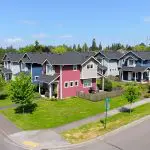
Rules for building townhomes, duplexes and other small housing forms in Bellingham.
Page last updated on:
What is middle housing?
At one end of the housing spectrum are single-family homes. At the other end are larger scale multi-family buildings, such as mid-rise and high-rise apartments. Middle housing describes home types at various price points and scales between those two ends of the spectrum.

Types of middle housing
Bellingham’s middle housing development and design standards apply to eight small housing forms that use limited space:
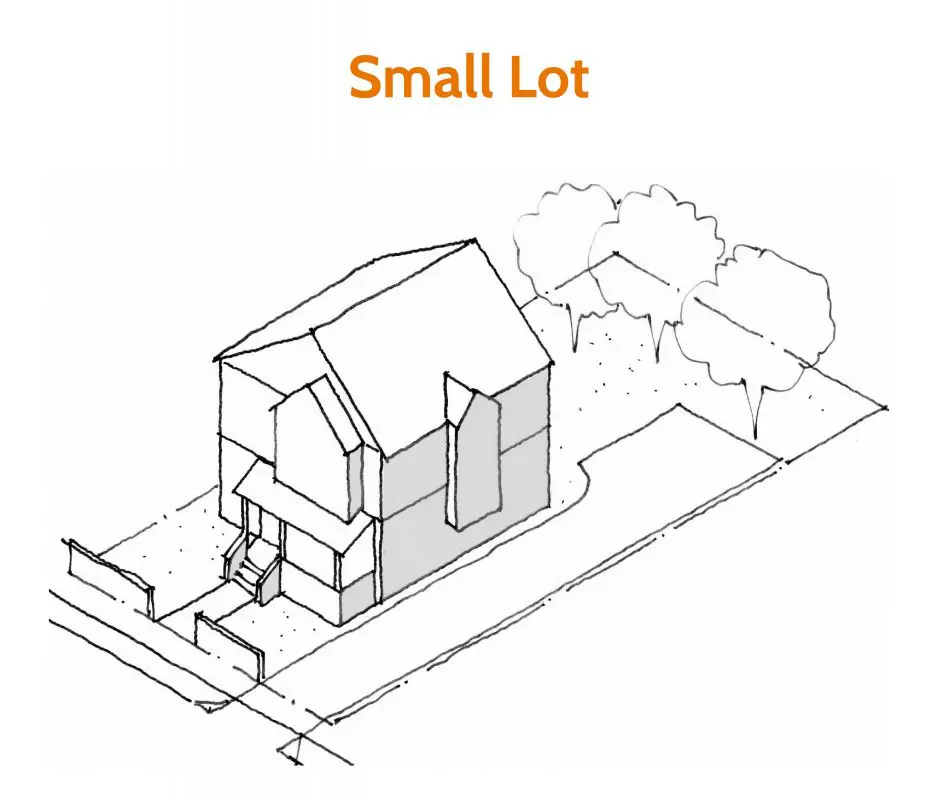
- Small lot detached single-family houses
- Cottages
- Duplexes
- Triplexes
- Fourplexes
- Shared courtyard housing
- Garden courtyard housing
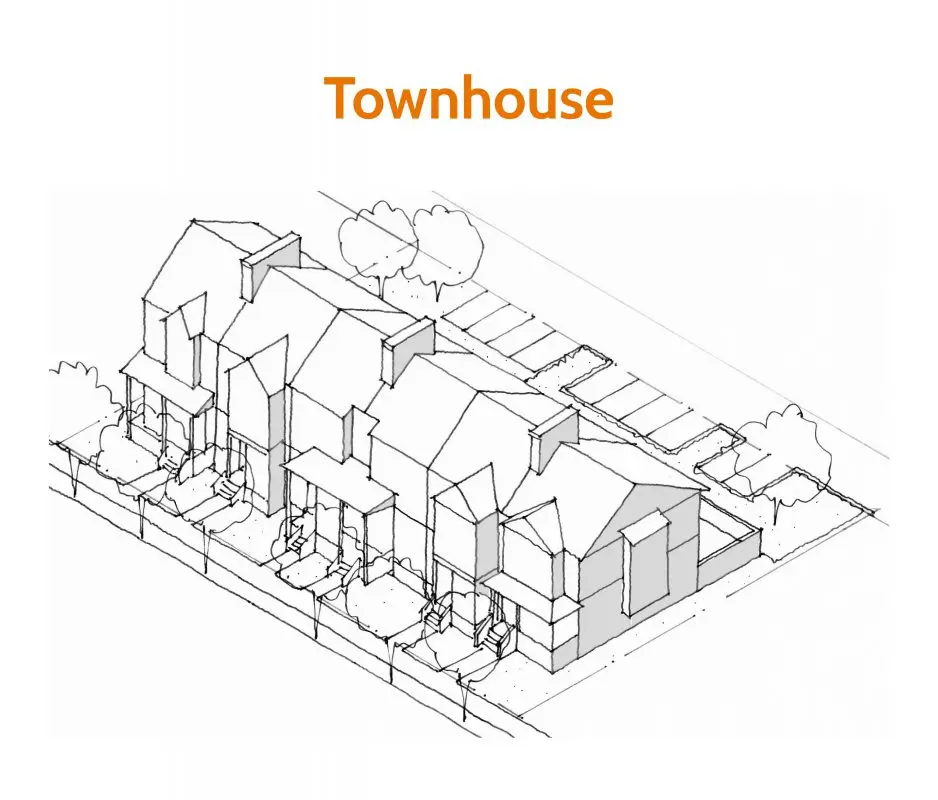
- Townhouses
There are additional middle housing forms with different development rules, such as Accessory Dwelling Units (ADUs).
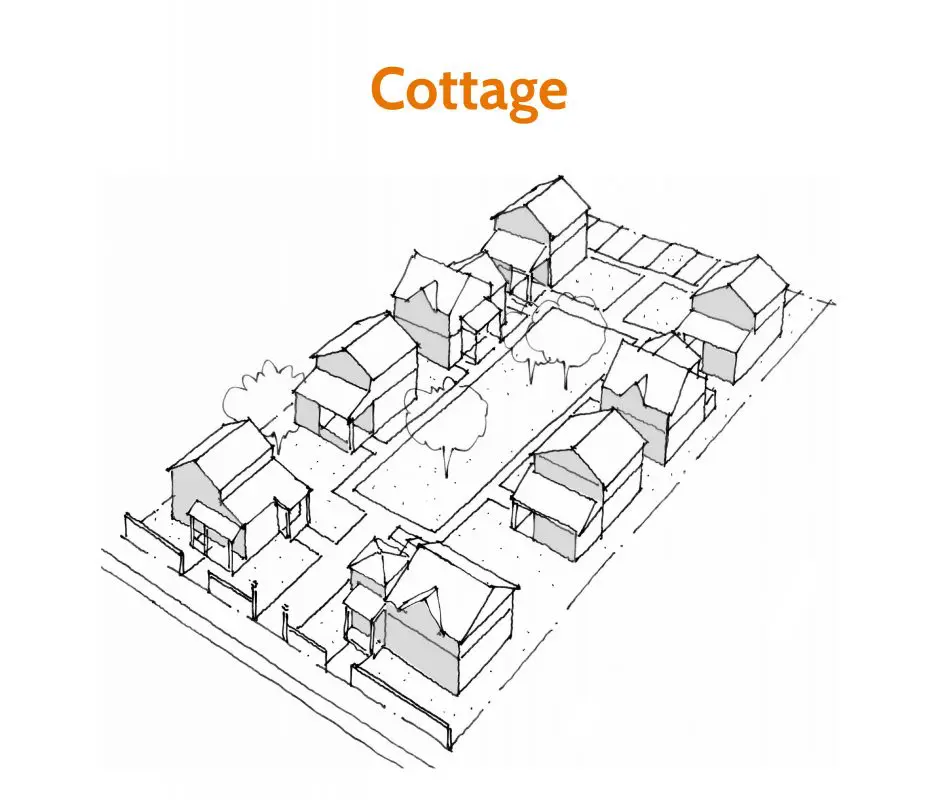
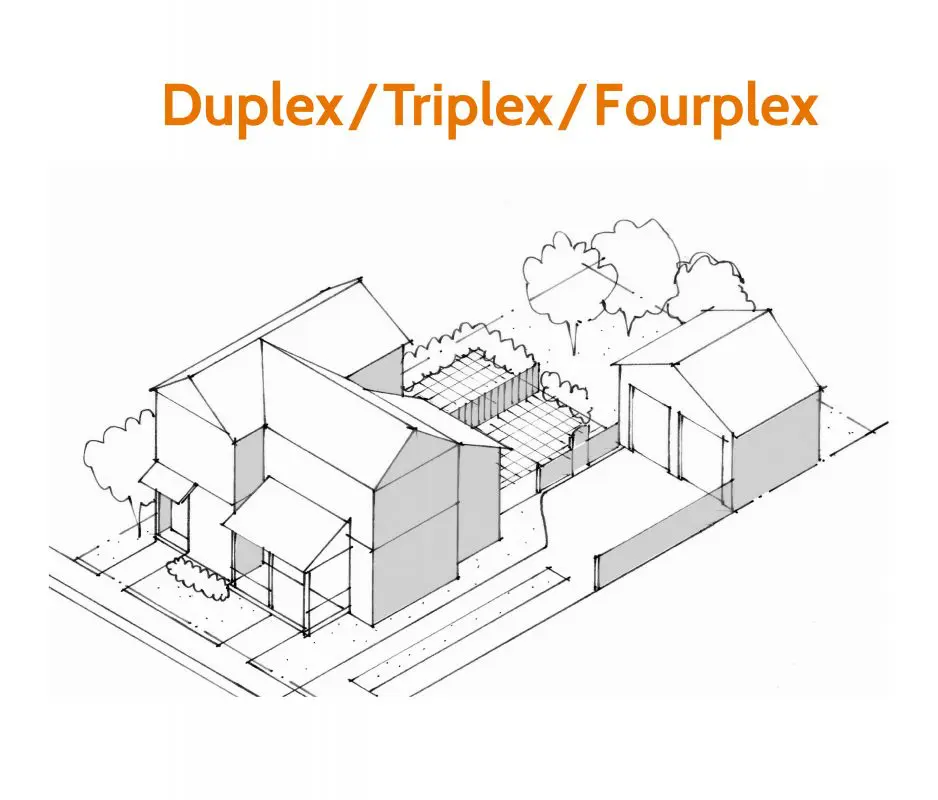
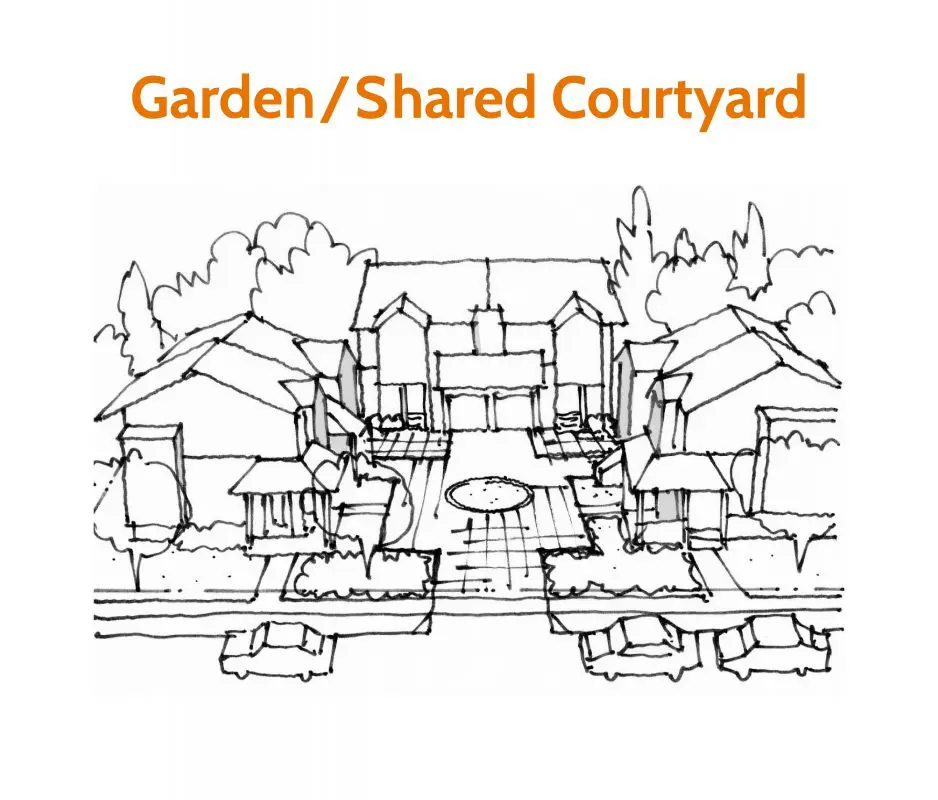
Middle housing development and design standards
In 2009, Bellingham adopted rules that made it easier to develop middle housing here, while establishing design standards that help them architecturally blend into existing neighborhoods. Since 2009, they have been updated to expand where middle housing is allowed, refine standards, and streamline the review process for small-scale projects.
Below you will find an overview of current middle housing development and design standards. Additional details can be found in the design standard details section below and in the Interim Middle Housing Ord. 2025-12-032.
| Where in Bellingham is middle housing allowed? | All areas that allow residential development (except for the Lake Whatcom watershed), including areas zoned residential single and residential multi, and in urban villages |
| Number of middle housing units allowed per lot – maximum density | Usually, up to four units are allowed per lot. Up to six per lot are allowed when the property is within half a mile walking distance of a major transit route, or at least two units are affordable housing. Sometimes properties contain enough land area to support multiple lots based on the Zoning Table minimum lot size. |
| Maximum building floor area allowed per lot size (referred to as floor area ratio) For the total floor area count, we include all existing and proposed building floor area on the property (including ADUs and garages). | Number of units | Total floor area max 1 unit | 60% of the lot size or 1,200 sq/ft, whichever is more permissive 2 units | 80% of the lot size 3 units | 100% of the lot size 4 units | 120% of the lot size 5 units | 140% of the lot size 6 or more units | 160% of the lot size |
| Usable space (for leisure or recreation) – min | At least 100 sq/ft of private usable space is required for each unit (no part of this area can be less than five feet wide or long). Private usable space must be directly accessible from the dwelling unit, and be separated from shared spaces or paths and other units through use of landscaping and/or fencing.* |
| Permits required | A design review land use permit and building permit (must have an approved land use permit prior to building permit issuance); some projects also require additional permits – contact the Permit Center for more information |
| Design standard details | Middle housing design standard details can be found below |
| Height – max | 35′ under height definition #1, or 20′ under height definition #2 (see definitions) |
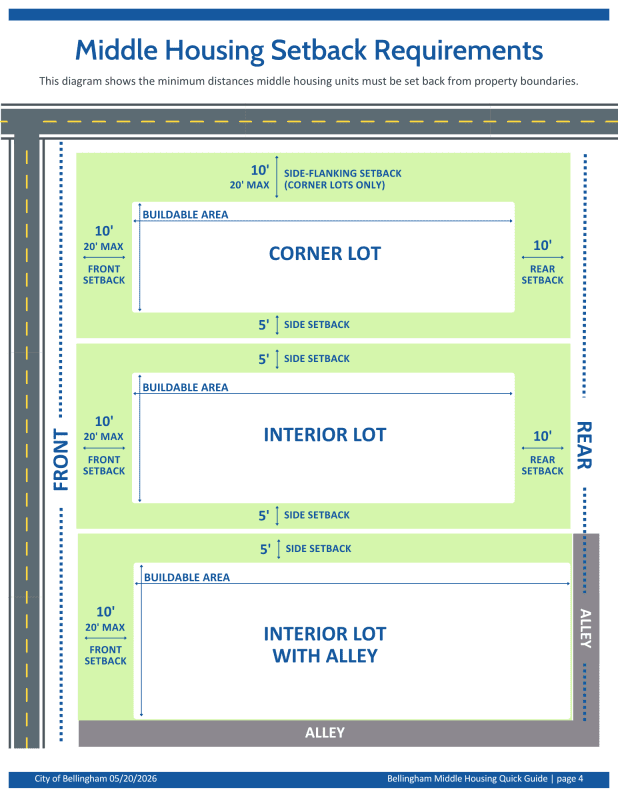
| Setback from property line (see diagram) | Front: 10′ min, 20′ max Rear: 10’ min Corner lot side flanking: 10′ min, 20′ max Alley: 0’ |
| Parking – min | None required, but if it’s added electively, it must meet all applicable parking standards** |
| Open space – min | 30% of lot |
| Permitting process | A Type I permit process is used for middle housing projects of six units or fewer (learn more) |
| Landscaping – min | A minimum Green Factor score of 0.3 is required |
| Street trees – min | One tree per every 40 feet of frontage is required along all streets, private lanes, and common pedestrian corridors. |
| Subdivision of land | Middle housing units are not required to be on separate lots. However, if subdividing is chosen, it requires a subdivision land use approval. When middle housing units are proposed as part of a land division, they don’t need to meet development standards individually as long as the subdivision as a whole meets those standards. |
| Street improvements | All abutting streets are required to be improved with curb, gutter and sidewalk across the full frontage of the land being developed. Each property is unique and exceptions might be available – check with the Permit Center to learn more. |
| Vehicle access from an alley | For lots abutting an alley, vehicular access shall be taken from the alley and not from abutting streets. |
**Parking standards for middle housing are found in BMC 20.12.010, BMC 20.28.050, Interim Middle Housing Ord. 2025-12-032 and Interim Design Review Ord. 2025-12-034. These include: Parking cannot be located between the dwelling unit(s) and the street or lane except as allowed in BMC 20.28.050; The maximum driveway width is 12 feet for infill units and single-family dwellings when the driveway crosses a pedestrian facility; Garages and carports must be set back at least four feet from the street face of the dwelling unit (front wall of the residence) facing the street; The width of the garages and driveways accessing a street or lane shall be proportionally less than the width of the dwelling unit.
Middle housing design standard details
The Interim Design Review Ord. 2025-12-034 specifies design standards for all middle housing. Additionally, there are infill general standards that define requirements for pedestrian-oriented design, common facilities, lanes, pedestrian corridors, parking, and landscaping – some are listed in the table above, others can be found in Bellingham Municipal Code (BMC) 20.28.050.
The middle housing permitting process
Permitting for middle housing requires both a design review land use permit and a building permit for construction. The review processes for both applications can be done together or separately, but you may be able to reduce costs by going through the land use permitting process before submitting your building permit application. In some instances, additional permits may be required, such as for subdivision or installation of public infrastructure. While the process for reviewing permit applications can vary, the vast majority of middle housing in Bellingham goes through a Type I permit review process.
Which permit process will my project require?
| Type I Process | Type II Process | Type III-B |
|---|---|---|
| Used for the vast majority of middle housing projects in Bellingham that meet standards in the Middle Housing Development Standards table.* See Type II and III to the right to learn when they would be used instead. | Required when a project consists of 7 or more dwelling units. | Required when creating 10 or more lots. |
| This is the most streamlined permit review process. | This process is slightly more time consuming for applicants because notification of surrounding property owners is required. | This permit process is the most time consuming for applicants because it requires notification of surrounding property owners, a neighborhood meeting, and a public hearing. |
Frequently Asked Questions